
Capabilities
- Customer Experience
- Product UI UX Design
- Development & Engineering
- Cloud Services
- Testing & QA
Industries
AI + Data
Insights
About Us
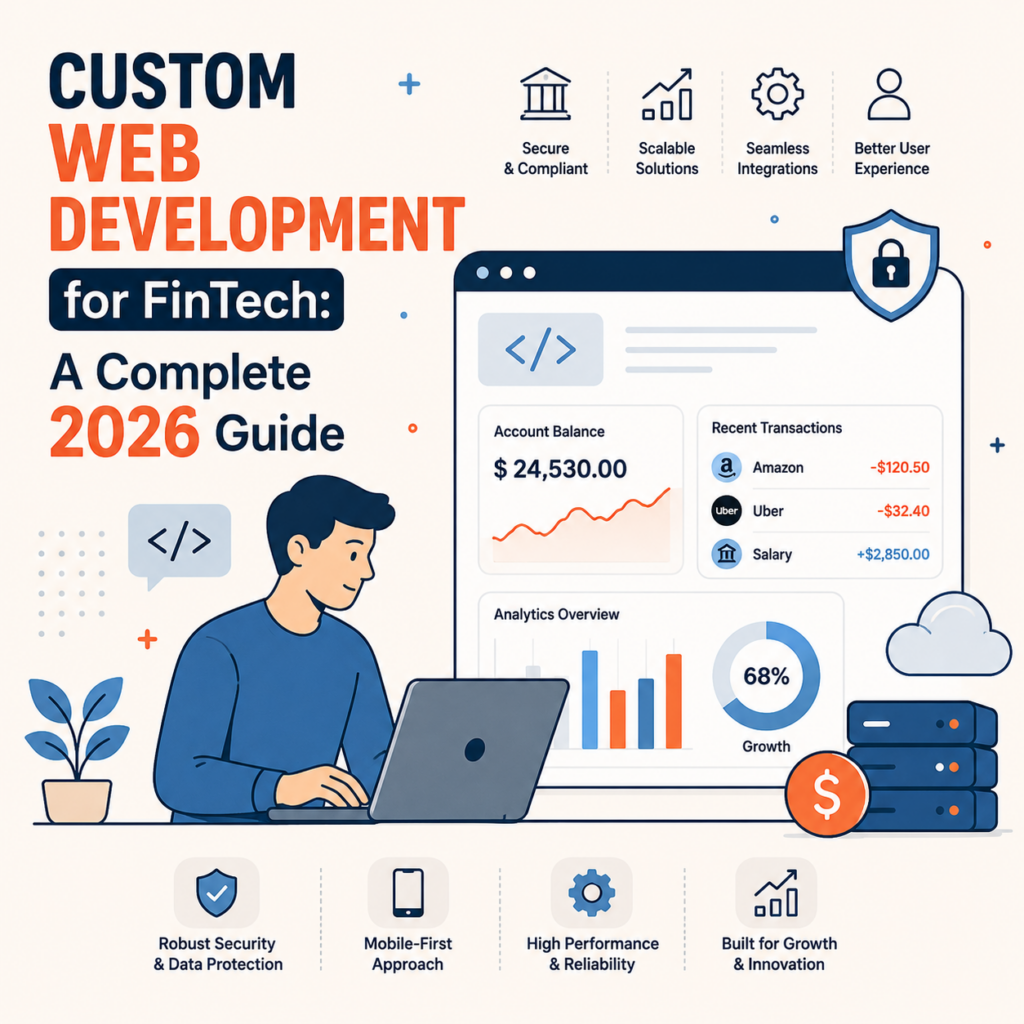
Custom Web Development for FinTech: A Complete 2026 Guide
Introduction
Off-the-shelf web platforms weren’t built for financial compliance — custom development is. Every time a bank, wealth manager, or insurance provider tries to retrofit a generic SaaS tool to meet SOC 2, PCI-DSS, or jurisdictional data residency rules, the cracks show quickly: workflow gaps, audit blind spots, and integration debt that compounds with every release.
The FinTech landscape in 2026 is more competitive than ever. Neobanks, embedded finance providers, and decentralized lending platforms are raising client expectations for speed, personalization, and security — simultaneously. Established institutions are being asked to match that experience while carrying the weight of legacy systems, strict regulators, and high-value data.
Custom web development has become a strategic differentiator rather than a cost center. A well-architected custom platform lets financial firms encode their compliance posture into the product itself, integrate cleanly with core banking and market data systems, and ship new features without waiting on a vendor’s roadmap. This guide walks through what custom web development means for FinTech, which features matter most, and how to deliver a platform that regulators, customers, and engineering teams can all trust.
What Is Custom Web Development?
Custom web development is the end-to-end process of designing and building a web application tailored to a specific organization’s workflows, data model, compliance requirements, and brand. Unlike template-based or off-the-shelf solutions, a custom build gives teams full control over architecture, security posture, user experience, and integration points.
In a FinTech context, custom development typically spans client-facing portals, internal operations tools, API layers that connect to core banking or trading systems, and administrative dashboards for compliance, risk, and finance teams. The goal is not to reinvent the wheel on every component — modern custom platforms lean heavily on proven frameworks and cloud services — but to shape the product around the business instead of the other way around.
The table below summarizes the practical difference between custom and template-based approaches for financial services.
| Dimension | Template / Off-the-Shelf | Custom Web Development |
| Compliance fit | Generic controls, gaps in audit trails | Controls designed around SOC 2, PCI-DSS, GDPR |
| Workflow support | Forces your process into the tool | Models your exact loan, KYC, or trading flow |
| Integration depth | Limited to vendor connectors | Direct API integration with core systems |
| Scalability | Shared tenancy, throttled limits | Cloud-native scaling for peak loads |
| Time to change | Waits on vendor roadmap | Ships on your release cadence |
| Long-term cost | License fees grow with usage | Higher upfront, lower marginal cost |
Why Financial Services Companies Need Custom Web Development
Financial services carry regulatory, operational, and reputational stakes that few other industries match. That reality shapes every decision about the technology stack.
Regulatory requirements are the first and clearest driver. SOC 2 Type II, PCI-DSS, GDPR, and a growing patchwork of regional financial regulations demand evidence-based controls: encryption at rest and in transit, granular access logs, documented change management, and verifiable data residency. Most off-the-shelf platforms treat these as add-ons; custom builds treat them as foundational design constraints.
Workflow complexity is the second. Loan origination, KYC and AML checks, trading dashboards, insurance underwriting, and wealth management reviews each involve long-running processes, conditional logic, human approvals, and integrations with specialized third-party data sources. Generic tools collapse under that complexity or force workarounds that create compliance risk.
White-label and multi-tenant requirements are the third. A growing number of FinTech firms sell their platform to other institutions — banks, advisors, brokers — who expect their own branding, their own data isolation, and their own configuration. Custom architecture makes that tenancy model safe and maintainable.
Related services: Software Development, Cloud Services.
Core Features of a Custom FinTech Web Platform
Every FinTech product is different, but the features below show up in nearly every serious platform. Treat this as a baseline checklist rather than a shopping list.
- Secure authentication and role-based access control, including multi-factor authentication, session management, and granular permissions tied to least-privilege principles.
- Real-time data feeds and dashboards for market data, transaction monitoring, portfolio performance, and risk indicators, with sub-second latency where the use case demands it.
- API integrations with banking APIs, payment gateways, KYC providers, custodians, and market data vendors, ideally through an internal API gateway that centralizes auth, logging, and rate limiting.
- Audit trails and compliance logging that capture who did what, when, and from where — retained according to the regulatory clock and exportable for auditors without engineering involvement.
- Admin and back-office tooling for operations, support, and compliance teams so that routine work does not require database access or custom scripts.
- A modular front-end design system that keeps the experience consistent across client portals, advisor tools, and mobile views.
Related services: Software Testing & QA, AI Solutions.
The Custom Web Development Process for FinTech
A disciplined delivery process is what separates platforms that pass an audit from platforms that accumulate technical and regulatory debt. A typical engagement moves through six phases.
- Discovery and requirements. Map the business workflows, the regulatory footprint, the integration surface, and the user personas. The output is a product definition that an auditor would recognize as well as a developer.
- Architecture planning. Choose the cloud posture, the tenancy model, the data classification scheme, and the security controls. Document threat models before code gets written.
- Agile development. Ship in short iterations with demos to stakeholders and compliance reviewers. Use feature flags to decouple deployment from release.
- QA and security testing. Combine functional QA, performance testing, and third-party penetration testing. Security findings should be triaged with the same rigor as functional bugs.
- Launch. Plan a phased rollout — internal, pilot customers, general availability — with clear rollback criteria and monitoring thresholds.
- Ongoing support. Treat the platform as a living product: regular dependency upgrades, control reviews, and a roadmap tied to business outcomes.
Real-World Use Cases
The patterns below illustrate how custom web development plays out across financial subsectors.
- Wealth management client portals that unify account aggregation, performance reporting, document vaults, and secure messaging between clients and advisors.
- Insurance quote and claims platforms that handle underwriting rules, document uploads, adjuster workflows, and payout tracking in a single system of record.
- Lending and credit underwriting tools that pull in bank transaction data, credit bureau pulls, and alternative data, then route applications through automated and manual review stages.
Common Challenges and Solutions
Three problems come up on nearly every FinTech build. Each has a well-understood solution when it is planned for early.
- Legacy system integration. Core banking and policy administration systems rarely offer modern APIs. The solution is an API-first architecture: wrap legacy systems behind an internal API layer so that the new platform integrates against stable, versioned contracts instead of brittle direct connections.
- Security vulnerabilities. Traditional security reviews at the end of a project catch problems too late. The solution is DevSecOps: automated dependency scanning, static and dynamic analysis in CI, and regular third-party penetration testing throughout the lifecycle.
- Scalability under peak loads. Tax deadlines, market opens, and marketing launches create spiky demand. Cloud-native infrastructure — managed databases, auto-scaling compute, and event-driven workers — absorbs those spikes without manual intervention.
Best Practices
A handful of principles separate platforms that age gracefully from platforms that need to be rebuilt every few years.
- Build with API-first design so that the web platform, mobile apps, and partner integrations all consume the same well-documented interfaces.
- Never sacrifice security for speed-to-market. A breach costs more in remediation, regulatory penalties, and lost trust than any feature delay.
- Invest in QA from day one, including automated test coverage on critical money movement and compliance paths, not just UI flows.
- Plan for observability. Structured logging, distributed tracing, and actionable dashboards are the difference between a fifteen-minute incident and a four-hour one.
Ready to build?
Planning a custom financial web platform? Let’s discuss your requirements and build something secure, scalable, and compliant.
Suggested Reads

Trending Resources




Idea Theorem™ is an award-winning UI UX design and Development agency which creates simple and usable experiences for web and mobile. Our human-centred design approach lets us understand your customers, identify their pain points & deliver solutions that enhance their experience with your brand.
Capabilities
Industries
©2026 Idea Theorem™ Inc.
All Rights Reserved.