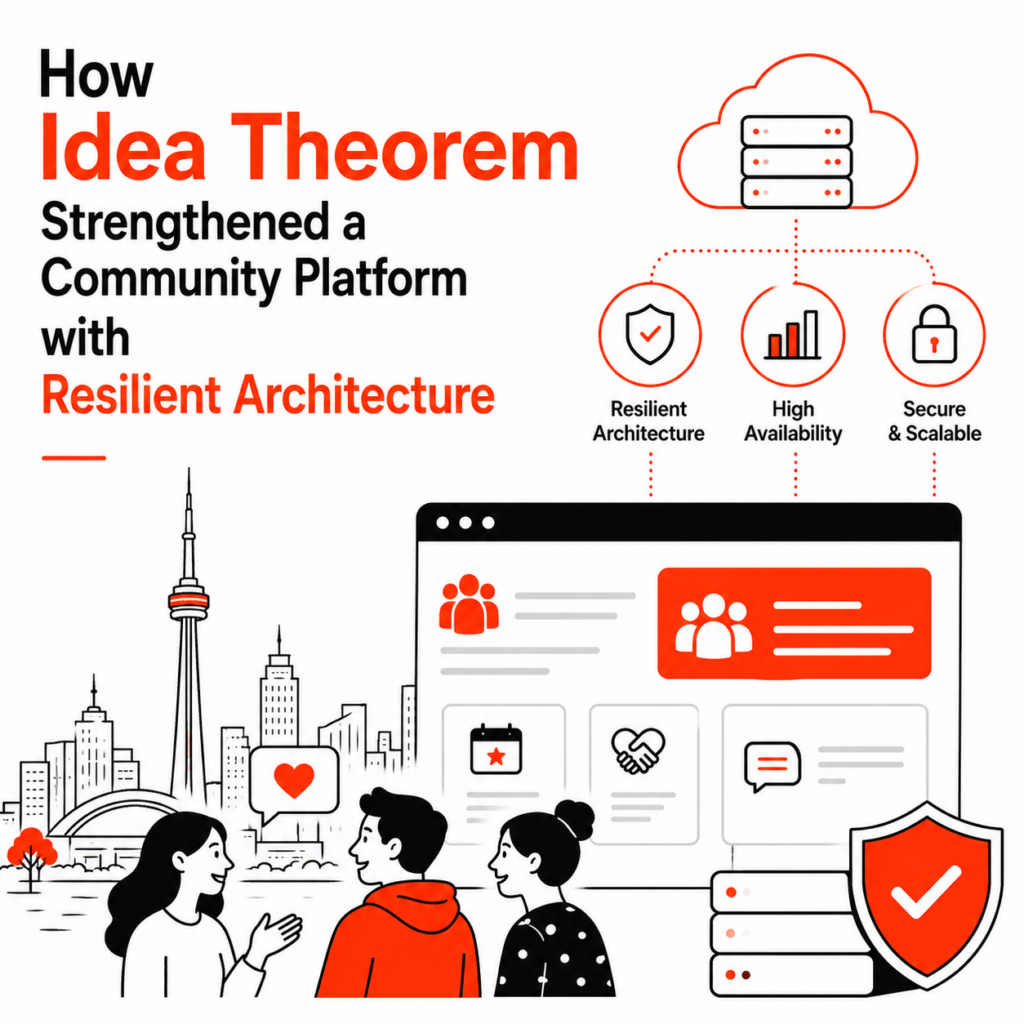
A public-sector case study on how Idea Theorem modernized community center registration and booking workflows and how external architecture advisory helped shape the platform’s reliability, disaster recovery, deployment safety, observability, and responsible AI roadmap.
Summary
This initiative focused on replacing antiquated “forms and files” processes with a digital platform for resident registration, facility and program booking, notifications, and improved staff operations. The public-facing work emphasized human-centered research, inclusive service design, and operational simplification for both residents and staff.
What will make this Insights piece distinctive is the technical story behind that public-facing result. Public-service platforms do not succeed on interface quality alone; they also need measurable reliability, safe deployment practices, traceable change history, strong access controls, and a credible roadmap for future analytics and AI. The advisory contribution from Yashasvi Makin can be framed as an external architecture and reliability review that helped translate product ambition into concrete engineering decisions: service-level objectives, multi-AZ resilience, staged regional recovery, safer CI/CD, better observability, and responsible ML governance. Those recommendations align closely with AWS guidance for Multi-AZ databases, Route 53 failover, CloudWatch canaries, CodeDeploy rollback, CloudTrail, AWS Config, and Model Cards, as well as the SRE guidance published by Google.
The architecture used was designed around a straightforward idea: stateless application services, durable managed storage, and explicit recovery paths. At the edge, CloudFront is used to deliver cached content from the nearest edge location, reducing latency for public assets and protecting the origin from unnecessary traffic. Cognito provides managed sign-up, sign-in, and access control for web and mobile applications, including self-registration, password recovery, and role-based integration with downstream services. That combination gives a public-service portal a cleaner and more scalable foundation than embedding authentication and asset delivery inside the core application tier.
For transactional data, the advisory architecture favored managed relational storage with high availability built in. Amazon RDS Multi-AZ deployments automatically maintain a synchronous standby in a different Availability Zone and provide automatic failover support; AWS documents typical failover time for this pattern as 60–120 seconds, depending on workload state. For stronger regional continuity, Aurora Global Database offers a multi-Region model with dedicated replication infrastructure and typical cross-region replication latency under a second. Combined with Route 53 failover routing, that creates a clear path from strong intra-region resilience to active-passive regional recovery when the service requires it.
This matters because public trust depends on how systems fail, not only how they behave on a good day. AWS Well-Architected guidance recommends defining recovery time and recovery point objectives before choosing a DR strategy, then aligning the architecture with those goals through standby or multi-Region patterns and regular drills. Delivery safety was another major area of improvement. The recommended approach used infrastructure as code with Terraform, backed by remote state in S3 with locking, versioning, and auditability. AWS Prescriptive Guidance is clear that an S3-based remote backend improves collaboration, state integrity, backup protection, and security for Terraform teams. On top of that infrastructure layer, the application release model should favor blue-green and canary deployments rather than all-at-once cutovers. AWS Well-Architected explicitly recommends safe rollout strategies such as traffic splitting, one-box, canary, and blue-green, and CodeDeploy can automatically roll back to the last known good revision when a deployment fails or alarms are triggered.
Recommendations also pushed observability closer to real user experience. The platform should not only know whether an instance is healthy; it should know whether a resident can log in, start registration, complete a booking, or submit a form successfully. CloudWatch Synthetics canaries are designed for that exact problem: they run scripted user journeys on a schedule, store timing data and screenshots, and can integrate with CloudWatch Application Signals and correlated X-Ray traces. Datadog complements that model with AWS account integration, API and browser-based synthetic tests, CI/CD triggers, and a unified view across metrics, logs, and synthetic monitors. Together, CloudWatch, X-Ray, and Datadog give the team a layered view that is closer to “is the service working” than “is the VM alive.”
Security and governance were treated as platform features, not afterthoughts. CloudTrail provides searchable account activity and API event history for operational auditing, governance, and compliance. AWS Config provides a historical view of how resources are configured, how they relate to one another, and whether they remain compliant with defined rules over time. IAM best practices emphasize least-privilege permissions, temporary credentials, and continuous refinement of access policies. For an environment handling resident data and staff workflows, those controls enable accountability when something changes and reduce the attack surface when something does not need access.
There were also practical performance recommendations that improve user experience without overcomplicating the system. S3 provides durable object storage for uploads, backups, and static artifacts, with 11 nines of designed durability and multi-AZ redundancy by default. CloudFront reduces latency for cached assets and protects the origin path. ElastiCache provides a managed in-memory layer with sub-millisecond or microsecond-level response times, which is useful for hot reads such as program catalogs, availability snapshots, and session-adjacent data that would otherwise increase pressure on the transactional database. In a community-service setting, these optimizations are less about raw scale and more about preserving headroom during peak registration moments.
The project also created a responsible foundation for future analytics and AI. Right now, the portal is primarily transactional. But if the center later wants demand forecasting, waitlist prediction, facility utilization analysis, or program recommendations, the right starting point is good telemetry and explicit governance. SageMaker Model Cards provide a structured way to document intended use, risk, evaluation results, and recommendations for ML models. SageMaker Model Monitor can detect drift in data quality, model quality, bias, and feature attribution over time. SageMaker Clarify adds bias detection and explainability workflows, while SageMaker Role Manager helps teams create least-privilege, persona-based IAM roles for data scientists and MLOps engineers. That means future AI can be introduced as a governed extension of the platform, not as a black-box layer on top of it.
That future roadmap should also be measured responsibly. If the platform evolves toward heavier forecasting or optimization workloads, the best next step is not to assume one accelerator vendor or one training stack. MLPerf Training from MLCommons exists precisely to compare how quickly systems reach a target quality metric, and those comparisons are more useful when they are paired with energy or emissions tracking rather than raw throughput alone. PyTorch now exposes mature CUDA and XPU backends, while AMD ROCm documents an upstreamed PyTorch path for mixed-precision and large-scale training. For teams running workloads on infrastructure they control, CodeCarbon offers a straightforward method for tracking carbon impact from CPU, GPU, and RAM power draw. Put simply: if portal ever grows into a data product, it should measure performance, cost, and sustainability together.
The architecture review ensured that those needs would be supported by a platform designed for continuity, safe change, and future evolution. In public-sector work, that combination is what turns a digital project into a trusted service.
Suggested Reads
Trending Resources