Introduction
Government agencies still running on 20-year-old legacy infrastructure are leaving citizens — and taxpayers — at a disadvantage. Long wait times for permits, licensing portals that crash during peak demand, and paper-based workflows that cannot keep up with modern service expectations are not just inconveniences; they are measurable losses of public trust.
The shift is already underway. Industry surveys consistently show that the majority of public sector organizations have begun some form of cloud adoption, and most federal and state IT strategies now treat cloud as the default for new workloads rather than the exception. The question for most agencies is no longer whether to migrate, but how to do so in a way that respects their unique compliance, security, and procurement constraints.
This guide walks through what cloud migration actually involves for government, why the business case has sharpened in 2026, and the practices that separate smooth modernizations from expensive stalls.
What Is Cloud Migration?
Cloud migration is the process of moving data, applications, and workloads from on-premise data centers or legacy hosting environments to cloud infrastructure — typically a combination of public, private, or government community clouds. The goal is to replace fixed, aging hardware with elastic services that can scale with demand and be updated continuously.
For public sector organizations, three migration patterns dominate. Lift-and-shift moves existing workloads to cloud virtual machines with minimal change — fast but not always cost-efficient in the long run. Re-platforming makes targeted updates, such as moving to a managed database, to capture more cloud benefits without a full rewrite. Re-architecting redesigns the application around cloud-native services and is the most work upfront but delivers the best scalability, resilience, and total cost of ownership.
Why Cloud Migration Matters for the Public Sector
Several pressures have converged to make cloud adoption a strategic priority for government agencies.
Budget pressure is the most visible. Aging data centers demand continuous capital investment for hardware refresh cycles, and vendor support costs for legacy systems rise sharply each year. Cloud shifts a significant share of that spend to an operating model that scales with actual use.
Security mandates are the second major driver. FedRAMP authorization, NIST 800-53 control families, and the federal move toward Zero Trust architecture all assume a level of automation, telemetry, and control granularity that is difficult to achieve on legacy infrastructure. Modern cloud platforms provide these capabilities natively and are audited against the same frameworks.
Citizen service delivery expectations are the third. Residents who bank, shop, and schedule medical appointments online expect similar experiences when they apply for a license, pay a tax bill, or request a permit. Meeting that expectation requires infrastructure that can evolve as quickly as the services built on top of it.
Finally, remote and hybrid workforce enablement — a lasting shift from the COVID era — has made secure, cloud-based access to agency systems a baseline requirement rather than a nice-to-have.
Related services: Cloud Services — Migration & Consulting.
Key Benefits for Government Agencies
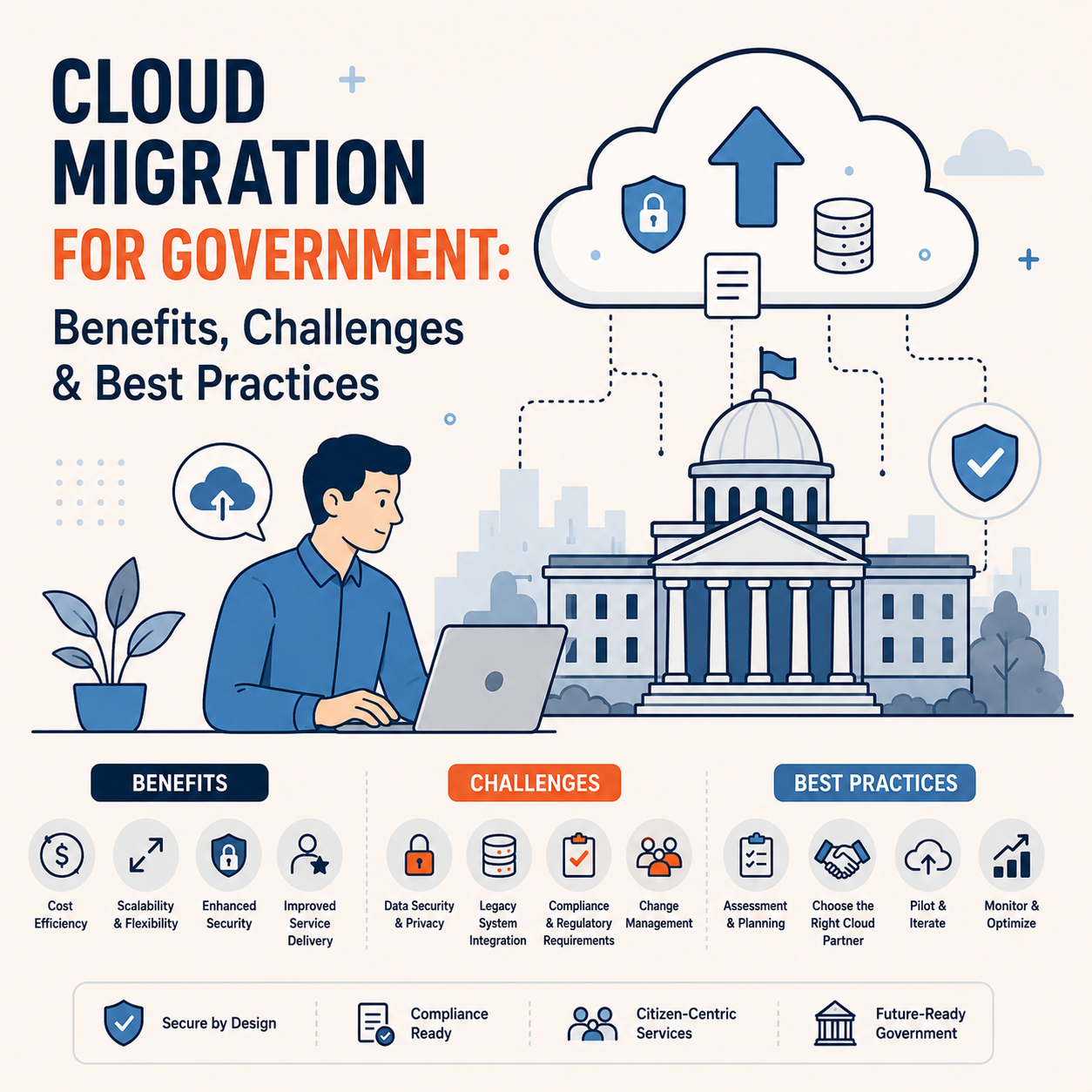
Done well, a cloud migration delivers compounding benefits across the agency’s cost, risk, and service posture.
How the Cloud Migration Process Works
Most successful public sector migrations follow a staged approach. Skipping stages tends to produce either stalled programs or risky big-bang cutovers.
Cloud readiness audits at the start of the engagement consistently produce the highest return on effort. They identify compliance gaps, quantify technical debt, and set realistic expectations with leadership.
Related services: Software Development, Software Testing & QA.
Real-World Use Cases
The following patterns illustrate how agencies of different sizes and missions apply cloud migration.
Common Challenges and Solutions
Three challenges come up in almost every public sector cloud program. None are unsolvable; all benefit from being addressed in the strategy phase rather than mid-migration.
Best Practices
The agencies that get the most value from cloud migration tend to follow a few consistent habits.
Ready to modernize?
Modernizing a government system or agency platform? Our cloud migration consultants have experience navigating public sector compliance requirements — from FedRAMP authorization boundaries to state-specific data residency rules.
Suggested Reads
Trending Resources