A customer sends a message about a delayed order. Resolving it requires more than a helpful response. Someone needs to check the order, review shipment updates, confirm the customer’s service agreement, and decide what to do next.
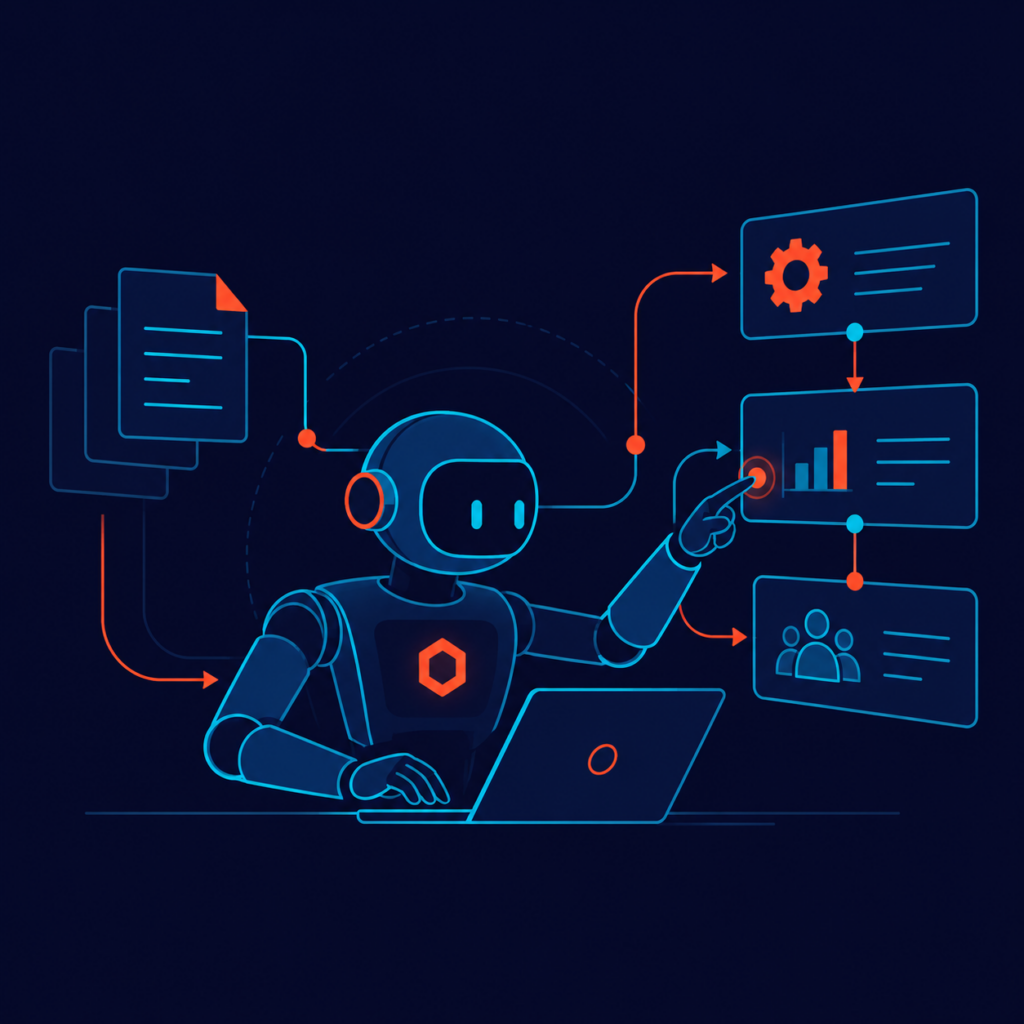
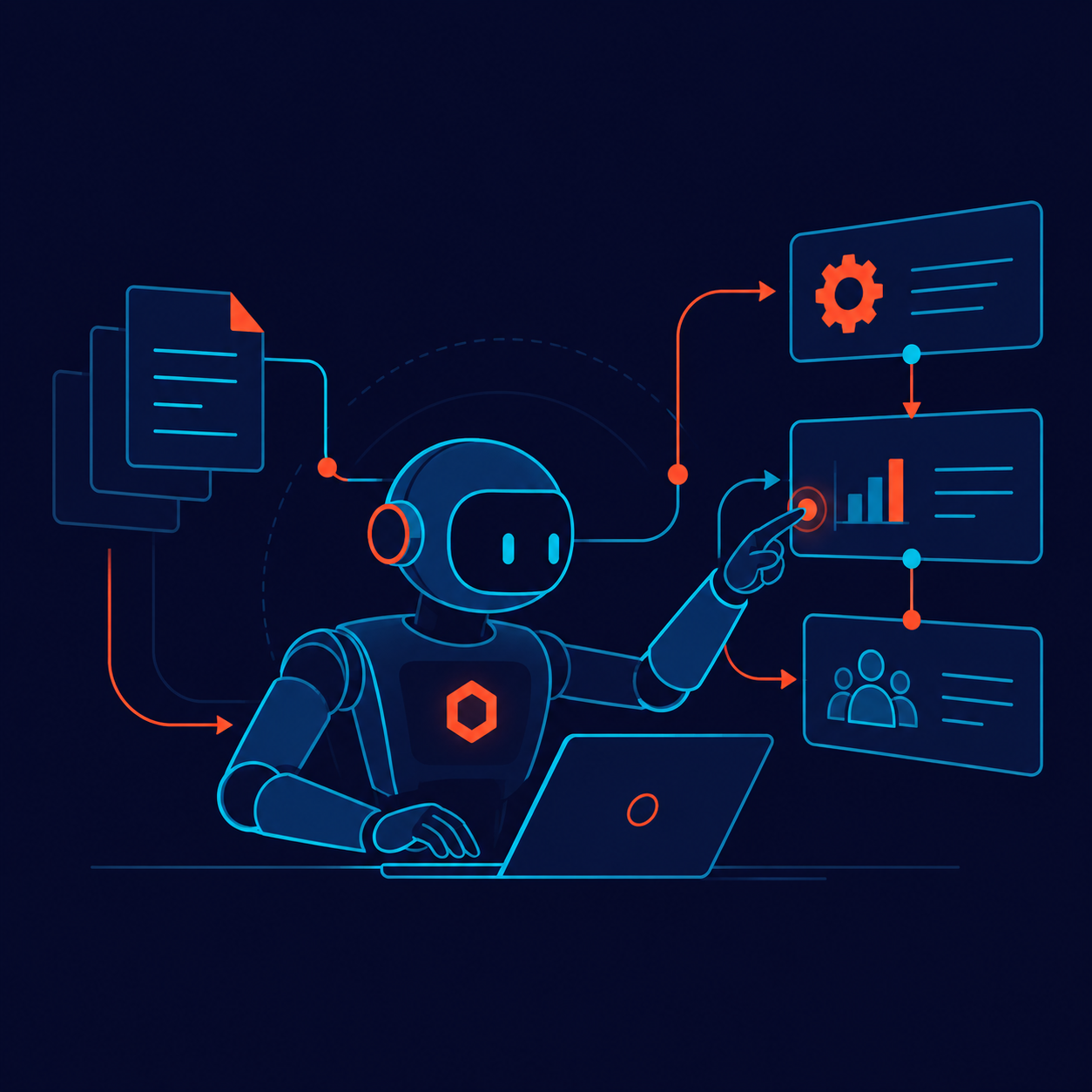
Traditional automation can handle predictable steps. An AI chatbot can explain the situation. Agentic AI can connect those steps, using approved tools and business information to move the request toward a resolution.
For enterprises, this creates opportunities to improve workflows that depend on information spread across multiple systems. However, useful autonomy requires clear boundaries, reliable integrations, and human oversight.
This article explores how enterprise AI agents work, where they can support business operations, and what organizations should consider before implementation.
Agentic AI describes AI systems that can pursue a defined goal by selecting actions, using tools, and adjusting their approach based on results.
Instead of producing a single answer, an agent may perform several steps. It can retrieve information, evaluate what it finds, take an authorized action, and check whether the task is complete.
There is an important distinction between workflows and agents. A workflow generally follows a predefined sequence. An agent has more flexibility to determine its next step during execution. Enterprise solutions can combine both approaches, using structured processes around tasks that benefit from adaptable decision-making. Anthropic’s guidance on building effective agents explains this architectural distinction.
Autonomous AI agents operate within permissions and objectives defined by people. Autonomy does not mean unrestricted access or independent responsibility for business decisions.
The right approach depends on how predictable the work is and how much judgment it requires.
| Approach | How it works | Illustrative business task |
|---|---|---|
| Rules-based automation | Executes predefined instructions | Routes an invoice based on its value |
| AI assistant | Produces answers or recommendations in response to a request | Summarizes an invoice discrepancy |
| Agentic AI | Selects and carries out permitted steps toward a goal | Investigates a discrepancy and prepares a resolution for approval |
These approaches can work together. A rules engine might enforce purchasing limits, while an agent gathers supporting evidence and a person approves an exception.
For a stable, predictable task, conventional AI automation may be sufficient. Agentic capabilities become more useful when the next action depends on information discovered along the way.
Consider an illustrative supplier onboarding process. The goal is to prepare a complete supplier record for review.
An agent could:
The process needs more than a language model. It also requires access to approved information, integrations with relevant applications, permission controls, and a way to track what happened.
If information is missing or conflicting, the system needs a clear escalation path. Completing a task should never depend on inventing details or bypassing an approval.
The following examples illustrate potential applications. Their suitability depends on the organization’s data, systems, operating requirements, and tolerance for error.
Support teams often switch between ticketing systems, customer records, documentation, and order management tools.
An agent could gather relevant information, classify the request, recommend a response, and complete permitted updates. For example, it might investigate a delivery issue and prepare a replacement request.
Sensitive actions, including refunds above an agreed limit or changes to contractual commitments, can remain subject to approval.
The potential benefit is a smoother resolution process with fewer manual handoffs.
Finance workflows frequently involve comparing documents and investigating exceptions.
Enterprise AI agents could help match invoices against purchase orders, identify discrepancies, and assemble evidence for review. In procurement, an agent might organize supplier documentation or prepare a comparison using approved evaluation criteria.
Payment authorization and supplier bank-detail changes require stronger controls. An agent’s ability to interpret documents should not automatically give it permission to move money or modify financial records.
IT teams handle requests that involve several diagnostic steps.
An agent could review a ticket, retrieve an approved troubleshooting guide, check permitted system information, and suggest a resolution. Where authorized, it could execute a limited remediation and verify the result.
Changes to production infrastructure or user access should follow established approval processes. Unsuccessful remediation should trigger escalation rather than repeated, uncontrolled attempts.
Sales teams can spend significant time assembling account information and maintaining customer records.
Agentic workflows could help prepare meeting briefs, identify incomplete CRM fields, and draft follow-up messages using approved information.
Commercial terms, pricing exceptions, and customer commitments still need clear ownership. The workflow should make it easy for a salesperson to inspect the evidence and approve the next action.
Internal service requests often require coordination across teams.
For employee onboarding, an agent could track checklist completion, identify missing documentation, and prepare requests for equipment or application access.
The system should respect access restrictions around employee information. Decisions about hiring, compensation, or performance require accountable human judgment and appropriate processes.
A strong use case has a specific outcome, accessible information, and clear rules for success.
Before implementing agentic AI, ask:
These questions help organizations choose workflows where autonomy serves a clear operational purpose.
When AI can act across business systems, incorrect output can lead to incorrect actions. Enterprise design must address both.
Give each agent only the permissions needed for its task. Reading a customer record, editing that record, and issuing a refund are different capabilities and should be controlled separately.
Define which actions require review, who approves them, and what supporting information they need. People should be able to correct or interrupt the workflow when necessary.
Documents, emails, and web pages may contain misleading information or instructions designed to redirect an agent. Retrieved content should not override business policies or grant new permissions.
Teams need visibility into the information retrieved, tools used, changes attempted, and exceptions encountered. This supports investigation and helps identify recurring failures.
Specify execution timeouts, retry limits, spending limits, and stop conditions. An unresolved task should end in a controlled handoff.
Microsoft’s guidance on managing agentic AI risk emphasizes scoped access, human control, monitoring, and layered security when managing autonomous agentic systems.
Start with a bounded process, such as preparing support cases for review. Define the beginning, the expected result, and the situations that require escalation.
Measure current handling time, error rates, manual effort, and cost per completed task. This creates a fair basis for evaluating the pilot.
Confirm that documentation is current and application access is reliable. Identify which systems are authoritative when records conflict.
A pilot can start by gathering information and recommending actions. Expand execution permissions only when testing demonstrates acceptable performance.
Evaluate incomplete submissions, conflicting records, unavailable tools, and misleading instructions. Routine success alone does not show how the system will behave under pressure.
Review results with the teams responsible for operations, security, and the affected workflow. Increase scope gradually while maintaining clear accountability.
Evaluate the complete workflow, including human review and correction.
Useful measures include:
A faster process is valuable only when quality and control remain acceptable. Compare pilot results against the baseline before committing to wider deployment.
Agentic AI offers a practical way to connect information, decisions, and authorized actions across enterprise systems. Its value depends on selecting the right workflow and designing the surrounding process carefully.
Organizations should begin with a clear operational problem, establish appropriate controls, and measure whether the solution improves the completed task.
Planning an agentic AI initiative? Connect with Idea Theorem to explore your workflow, assess integration requirements, and define a practical implementation roadmap.
Agentic AI in the enterprise refers to AI systems that can perform multiple steps toward a business goal. They use approved information and tools, adapt to intermediate results, and operate within defined permissions.
A chatbot primarily supports conversation and answers questions. Enterprise AI agents can also perform actions across connected systems, such as retrieving records, preparing updates, and routing work for approval. Some chatbots include agentic capabilities.
Agentic workflows combine business process steps with AI agents that can choose how to complete specific tasks. They may include tool use, conditional actions, human approvals, and exception handling.
Some bounded, lower-risk tasks can run with limited intervention. The appropriate supervision depends on the consequences of error, the permissions involved, and the organization’s policies. Sensitive actions need suitable review and accountability.
Agentic AI can extend existing automation. Rules-based systems remain useful for predictable tasks, while agents can support steps that require interpretation or an adaptable sequence of actions.
Choose one well-defined workflow, measure current performance, and confirm that reliable data and integrations are available. Start with limited permissions, test exceptions, and expand only after evaluating quality, cost, and operational risk.
Suggested Reads
Trending Resources